



TriShieldRAG
Our arXiv paper end to end: three rings of defence for RAG, and the attack that gets past them.
Full-subject study guides in handwritten-style notes, from first principles to the research frontier. Every topic page gives you the idea, one clear figure, the maths as steps and a code skeleton. Every Atlas ends with solved problems, an exam page, a cheatsheet and mnemonics.
Every Atlas we have today and every new one we publish, on one account. 48 Atlases today.
Short, carefully made PDF guides on one topic each, in the KinetixAI style: the story, the math, and the code. Buy once, yours to keep.
48 Atlases ready to read now. Pages 1 and 2 of every Atlas are free; everything after that is paid.
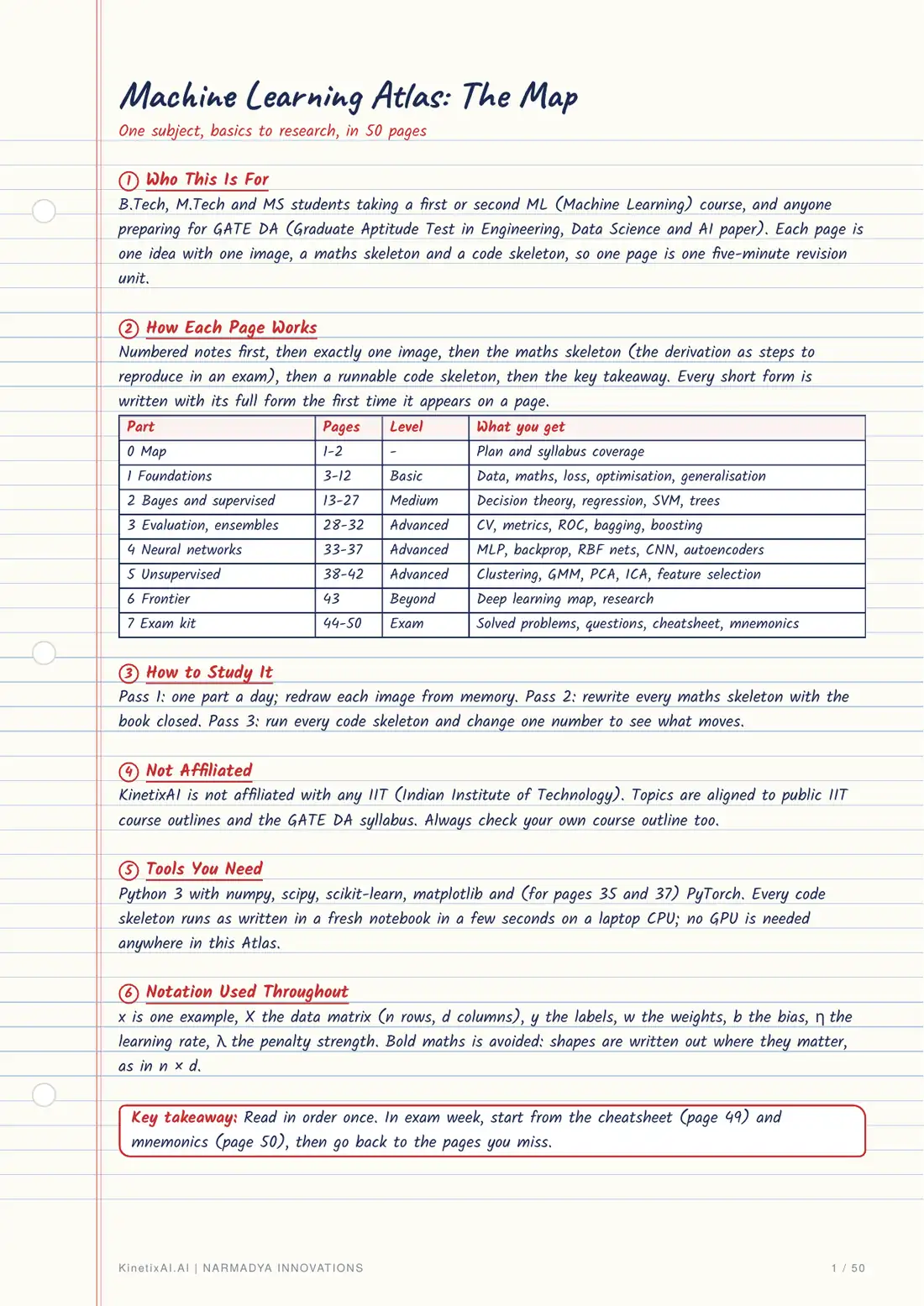
Probability and linear models to SVMs, trees, ensembles, clustering and neural nets.
CNNs, RNNs and LSTMs, attention and transformers, optimisation, GNNs, VAEs and GANs.
Search, constraint satisfaction, logic, planning, Bayes nets, MDPs and reinforcement learning.
Perceptron to backpropagation through time, built up one equation at a time.
Logic, proofs, sets, combinatorics, graphs, number theory, probability and linear algebra.
Amortised analysis, advanced trees and heaps, graphs, flows, DP, strings and NP-completeness.
Pixels to segmentation: filtering, frequency domain, restoration, morphology, features.
Camera geometry and SfM to detection, segmentation, ViT, CLIP, diffusion and NeRF.
Tokenisers, n-grams, HMM and CRF taggers, seq2seq, transformers, decoding, MT and LoRA.
Meaning: semantics, parsing, entities, inference, QA, dialogue and what LLMs still miss.
Decision theory, utility, value of information, POMDPs, filtering and game theory.
Attention in depth, state-space models, scaling laws, diffusion, self-supervision and alignment.
Gating and load balancing from 1991 to today's sparse LLMs, and how to serve them.
CUDA from threads and warps to shared memory, streams, profiling and real kernels.
Hopper and Blackwell, FlashAttention, FP8, NCCL, parallelism, vLLM serving and MIG.
Building LLM agents end to end: tools, memory, planning, multi-agent design and evaluation.
Model Context Protocol and Agent2Agent from the current specs, with their threats.
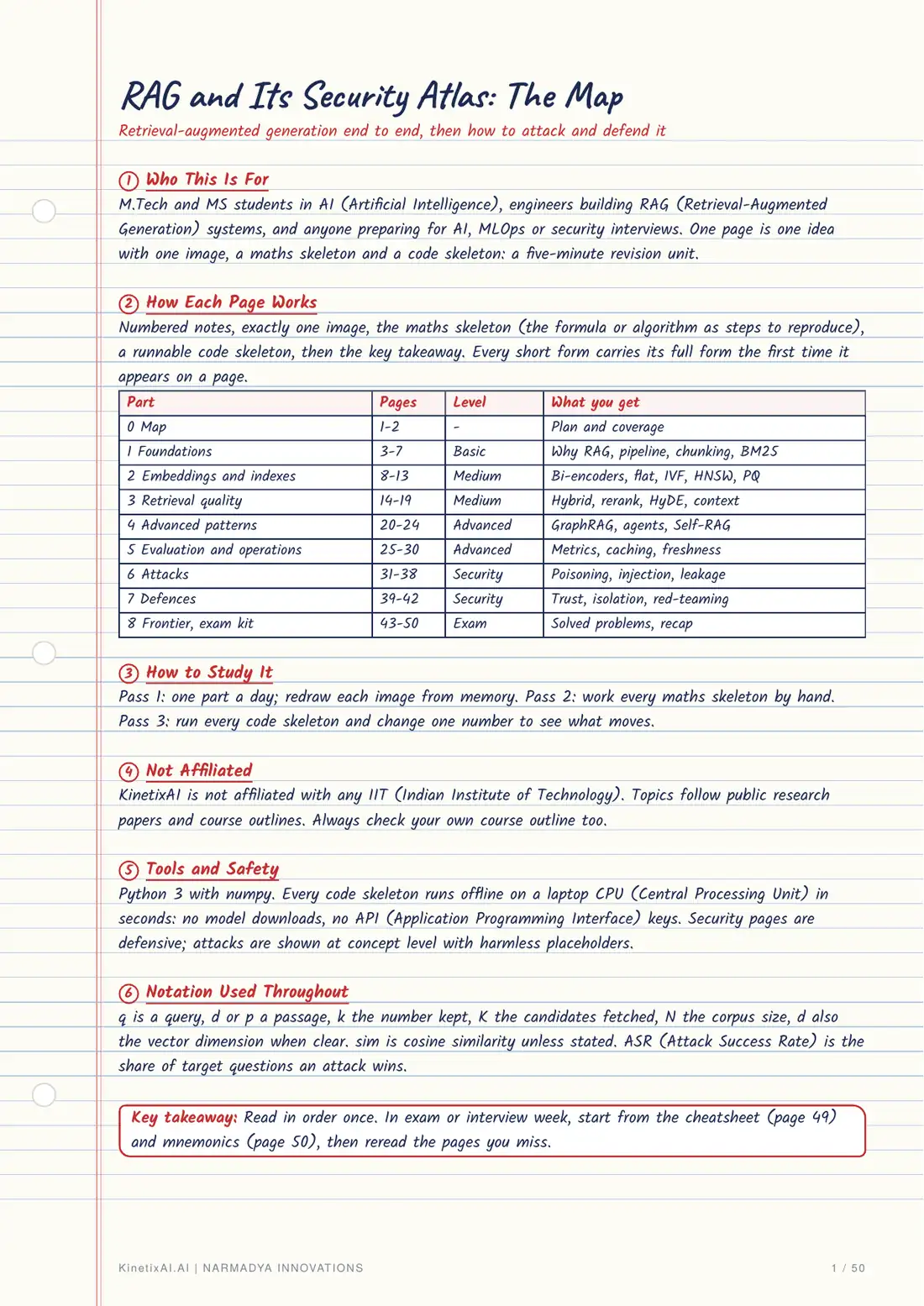
Retrieval-augmented generation end to end, then how to attack and defend it.
Shipping LLM apps: evals, serving, observability, cost, and the OWASP LLM Top 10.
SRE signals to anomaly detection, root-cause analysis, and securing the AIOps stack.
Our arXiv paper end to end: three rings of defence for RAG, and the attack that gets past them.
Search, planning, logic and probabilistic reasoning, implemented and run, not just stated.
scikit-learn 1.9 and pandas 3 from first fit to a full evaluation pipeline.
Tensors and autograd to a transformer from scratch, in current PyTorch, JAX/Flax NNX and Keras 3.
Embeddings, intent and entity extraction with spaCy, sentence-transformers 6 and transformers 5.
Tokenizers, classic text pipelines and a Hugging Face Trainer run, on CPU, end to end.
OpenCV 5 fundamentals through torchvision and a YOLO26 detector, run and inspected.
Numba CUDA kernels, CuPy, JAX and Triton, with 34 of 34 runnable skeletons passing.
CUDA 13.5 and cuda.core 1.3 from the platform and runtime side, with NVRTC compilation.
General-purpose GPU code beyond NVIDIA: PyOpenCL, wgpu, ROCm, oneAPI and Apple MLX.
MuJoCo 4, Gymnasium, Stable-Baselines3 and LeRobot 0.7 for learned robot control.
ROS 2, kinematics, control and SLAM, the classical robotics stack in code.
ONNX Runtime, LiteRT, ExecuTorch and OpenVINO for models that ship on-device.
A tiny GPT from scratch, GGUF quantization, and LoRA/QLoRA fine-tuning with DPO.
Python 3.15, checked, from core language features to the idioms AI code actually uses.
Offline agent patterns, MCP 2.x, A2A 1.0, and a Mixture-of-Experts layer run on CPU.
Experiment tracking, model registries, packaging and serving, in current tools.
Operating deep-learning training and serving at the scale MLOps alone doesn't cover.
Prometheus/OpenTelemetry metrics, anomaly detection, Drain3 log parsing and ChatOps.
Prompt versioning, eval harnesses and serving for LLM-backed applications.
NVML and DCGM metrics, MIG/MPS sharing, the GPU Operator, DRA and Kueue scheduling.
Batching, KV caches, quantization and serving frameworks for low-latency inference.
Profiling, kernel fusion and memory-bandwidth tuning for AI workloads that are too slow.
OWASP's 2026 LLM Top 10, red-teaming with garak and PyRIT, and PII redaction with Presidio.
boto3, Bedrock, AgentCore and SageMaker AI, tested locally against moto.
google-genai, Vertex AI's Agent Platform and the Agent Development Kit (ADK).
Azure AI Foundry, AI Search and Azure ML v2 from the Python SDKs.
Slurm job scripts, mpi4py with real multi-rank runs, DDP/FSDP2 and checkpointing at scale.
No Atlases in this group yet.
Every Atlas we have today and every new one we publish, on one account. 48 Atlases today.
Semester pack, any 4 Atlases for one price: coming soon.
One idea per page, so one page is one short revision session.
Short numbered notes in plain words. Every short form is spelled out the first time.
A single drawn figure that shows the idea, made from a real computation.
The derivation as steps you can reproduce in an exam.
A short code skeleton that runs on a laptop, then one key takeaway.
Six kinds of reader, one library. Start with the Atlases picked for you.
Check page 2 against your syllabus, then work the solved problems, the exam page and the viva questions. The cheatsheet and mnemonics are for the night before.
Take them in order: maths, machine learning, neural networks, deep learning, then language. Every idea comes with code you already know how to run.
GPU kernels and memory, parallelism and serving, sparse models, evals, cost and observability: what you need when the model has to run in production.
How agents, tools and RAG systems are built, and how they are attacked: prompt injection, poisoning, tool abuse and protocol threats, with defences that hold.
Decision theory and games, scaling laws, state-space models, diffusion and mixture of experts, plus our own papers written up in full.
Licences for a whole class or an engineering team are on the way. Tell us what you teach or build and we'll set it up with you.
Write to usResearch Atlases are our own papers, written up page by page: the problem, the method, every number and how to reproduce it.
Our arXiv paper end to end: three rings of defence for RAG, and the attack that gets past them.
Our reproducible on-prem benchmark for LLM root-cause analysis in AIOps.
Email me when it's readyMulti-cluster, multi-domain root-cause analysis for production systems.
Email me when it's readyOur GPU research, written up as a full research Atlas.
Email me when it's readyAnyone can ask a chatbot for notes and publish whatever comes back. Every Atlas and Primer passes four checks before it ships.
Developers, SRE and AIOps engineers, and published AI researchers: professionals who build and run production AI and cloud systems every day. Not a one-shot prompt.
Worked examples are computed in code. Code skeletons are run before release, and library versions are checked against the real release.
Several review passes before anything ships, the way a production change is signed off. Never a single AI draft taken at face value.
Every claim is checked against the paper, spec or official docs it comes from, not against what a model remembers.
Handwritten-style pages, one figure per page, a cheatsheet and mnemonics, so you remember it after the exam.
One payment. Read online on any device, or download the PDF.
Pages 1 and 2 of every Atlas are free: the plan of the Atlas and its syllabus map. Everything after page 2 is paid.
No. Atlases are sold on their own: one at a time, or every Atlas with the Atlas Pass.
All 50 pages to read online, and the full PDF to download. It stays on your account.
Checkout takes UPI in INR today. Card payments for other countries are coming; write to us and we'll tell you when they open.
Page 2 of every Atlas maps its topics to the syllabus it follows, and it's free to read.
No. KinetixAI is not affiliated with any university. Each Atlas names the public syllabi it maps to.
KinetixAI is not affiliated with any university. One-time purchase for personal use.
I'm KXAI. Ask about KinetixAI (Paper Lab, Primers, plans, your account, the docs) or about AI and ML research. Product answers come only from our pages and show their sources; general research answers are labelled as such.
Questions about a Paper Lab paper's tabs get an instant answer from our notes; everything else is answered by an AI model, checked for safety. Don't share personal data. AI can make mistakes. How it works